November 2025 news!
What happened in November 2025 at Phyto-info… we tell you all about it!
Hello everyone 🌿
Death by cyanide… Cyanogenic glycosides are widely present in rosaceae, such as apricot, cherry, apple, and plum trees, and yet we consume them happily without fear of the consequences… Where’s the catch? 🤔
A little bit of chemistry to see things a little more clearly. Cyanogenic glycosides are stored in the vacuoles of plant cells. What is a vacuole? It’s like a storage bag that takes up a large portion of the cell’s interior space. The cyanogenic glycosides in this vacuole are almost harmless. However, if the vacuole breaks, for example due to chewing by ruminants or digestive enzymes present in the consumer’s stomach, the cyanogenic glycosides degrade and are transformed into molecules of glucose, hydrocyanic acid and benzaldehyde. So what, you might ask? Well, hydrocyanic acid, commonly known as cyanide, is the problematic part, the part that poisons the victim. Benzaldehyde, on the other hand, is harmless and gives the product its characteristic bitter almond aroma. The bitter almond flavor is usually associated with the presence of cyanide, but caution is advised: there can be an almond flavor without cyanide and cyanide without an almond flavor.
But then why do we eat apricots, cherries, apples or plums? Because the sweet flesh of the fruit is edible, and the deadly secret lies mainly in its seeds or pits. Since this part is generally not consumed or is ingested only in very small quantities, the risk is minimal.
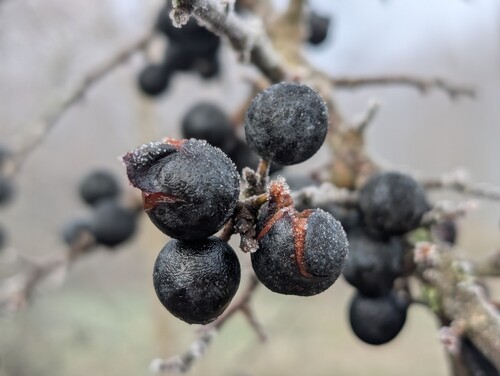
The blackthorn, the ancestor of the common plum tree, is no exception to the rule. While eating the fruit and discarding the pit prevents poisoning, biting into the fresh flower damages its tissues and triggers the release of bitter almond and cyanide flavors. Conversely, infusing the dried flower without crushing it in simmering water does not cause the degradation of cyanogenic glycosides and, therefore, does not lead to the release of cyanide.
Hoping that this information has been enlightening without being too alarming, we now invite you to explore the beneficial properties of dried flowers and fruits of the blackthorn, taking care, of course, to remove the pits.
New plants 👏
- Blackthorn (Prunus spinosa)
- Plum tree (Prunus domestica)
- African plum tree (African Prunus)
Immerse yourself in the world of plum trees, and discover how they are used on our platform.
Plant updated 👏
- Stinking chamomile (Anthemis cotula)
Syrup workshop 👏
🗓️ December 14, 2025 from 1 p.m. to 3 p.m.
We know syrup, but how do you prepare it yourself?
The workshop is full 🤗 More info on our website phyto-info.com/atelier.
Another gem 👏
Pierre, M., & Lis, M. (2022). Secrets des plantes pour se soigner naturellement. Artémis éditions.
Michel Pierre is known for having taken over and run for many years the family and historic herbalist shop “L’Herboristerie du Palais Royal” in Paris. Michel Lis, nicknamed Michel the gardener or green moustache, was a French journalist, known for having hosted the column Michel le jardinier on France Inter.
🌿 🌻 🌾
This was the news for our month of November, if you are interested in our search tool, more info on phyto-info.com.
To discover our plant finder, head to this page.
And if you have any questions, please do not hesitate to contact us 🤗
Next newsletter in a month! Stay tuned!