Our search tool — medicinal or not?
Beware of the cousins of medicinal plants, which make themselves believe that they are also medicinal. Maybe they are, you just have to be sure.
Survivalists tell us that there are edible plants all around us, and I want to believe them. I was surprised to learn that linden leaves could be eaten in salads… Before for me, linden was the evening infusion, now it is also a food reserve just in case, in the same way as my redcurrants. These, on the other hand, are not very good, but as they say due to lack of thrush we eat blackbirds.
So, speaking of for lack of thrush we eat blackbirds, I was wondering if the paths, the forests, the fields, the gardens were full of alternatives that you could gather very close to home when you don’t always have the plant that fits well in your pharmacy.
Uh, the plant that’s doing well?
I think I’ve already said it, I like the idea of the local medicine cabinet. We have a problem and presto we go down to the garden to find what we need. You just have to be careful with the cousins of medicinal plants, who make themselves think that they are also medicinal. Maybe they are, you just need to be certain.
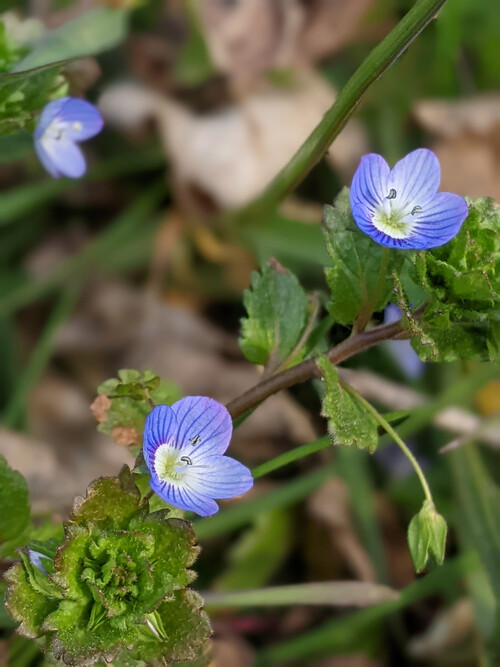
For example, we are at the moment when Veronique shows the tip of her nose. What interests me is to know if this plant, which is generally considered to be a weed and which grows by itself in my garden, could make my life easier and enter my pharmacy. I know Veronique officinale, but would this particular Veronique do the job just as well?
There are more than 20 Véroniques in my Delachaux, Véronique Mouron d’eau, des champs, Aquatic, Spring, Digitée, and so on. Mine seems to be a little oak or a precocious one… to be confirmed! If you know it, tell me!
After Googling it, I couldn’t find anything for the precocious one, but for the Petit-Chêne, I landed on a site that seems serious, the people who contribute to it are all passionate about plants and have professions related to medicinal plants. So far so good! Their page Véronique Petit-Chêne (Véronica chamaedrys) lists the various therapeutic benefits of this plant… hooray! A look at the sources, perfect they are listed. Oh wait, they list Treben and Valnet, that’s good, these books are in my library!
So I’m taking a look at it just to be sure.
Maria Trében for example, in Health at the Good God Pharmacy, on page 133, does not talk about Véronique Petit-Chêne, she only talks about the virtues of Veronica officinalis… Same story for Jean Valnet in Phytotherapy on page 501, he talks to us about Veronica officinalis, not about Petit-Chêne. Argh! Why not mention it on their website? Why use inappropriate references? Does Veronique Petit-Chêne have the same benefits as Veronique officinalis? For example, there is a difference between dyer chamomile and matricaria, the former has no virtue, while the latter does not need to be proven.
I had to delve into the research articles to understand that the two types of veronique were used interchangeably. A 2017 study uses DNA to identify species of veronica sold under the name Veronique officinalis. They discover Little Oak almost every time. The good news is that little oak is not toxic, it would have been known since time with substitutions. However, I have not yet found out if it has properties equivalent to officinalis. Because in the end, what we want is to relieve our ailments with plants that have properties, not placebos.
As you will have understood, it was a very small rant against sites that lack precision, I will discuss in a future newsletter the problems encountered when classifying ailments.
See you very soon for the next phyto-info newsletter!
sylvie