Our search tool – ailments of yesteryear!
It is not a question of listing everything that can be found in the books, especially when they refer to ailments that were not fully understood at the time.
“In the 18th century, [Yarrow] was the subject of numerous dissertations (Baier, 1714; Henninger, 1718; Hoffmann, 1719); where it was recommended either […] as an antispasmodic against hysteria and even epilepsy, or against renal colic and to prevent the formation of stones.” (Fournier, 2010, p. 36)
As I began to list all the pathologies listed in Fournier’s book on the page Yarrow, I automatically noted that this plant could be useful in case of hysteria, which did not fail to make my youngest daughter, who by the way, just celebrated her 26th birthday, come out of her senses. It doesn’t make me feel any younger. “Finally Mom” she told me, “you’re not going to say in Phyto-info that hysteria is a disease… Didn’t you see the movie Hysteria?”. Well I have seen this movie, which recounts the life of Dr. Mortimer Granville, inventor of the vibrator as a remedy for alleged female hysteria.
Recently, I talked about the role of data and the importance of choosing books. Indeed, to feed our search tool on medicinal plants with trustworthy data, it is “just” enough to remove unfounded sources from the equation… child’s play. While one of my main tasks is to sort through the books, I also have to clean up the information presented in these books.
Is it spring cleaning or what?
What I mean is that not all information is worth noting. The aforementioned extract clearly demonstrates that sometimes one must be careful about what one highlights, because of course “hysteria” in the context of the time did not mean somatoform disorders or histrionic personality disorders in women as in men (medical dictionary), but rather a neurotic disorder exclusively reserved for the female gender which could only be relieved by very special means, which was judged to be sexist and degrading. One wonders why!
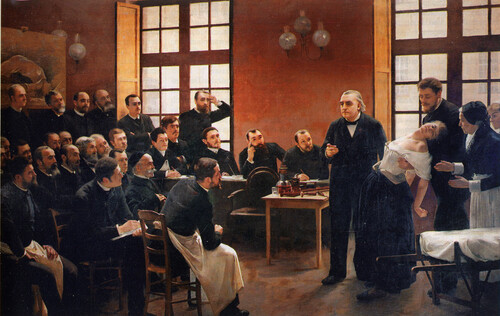
The illustration for this post is a painting created in 1887 by André Brouillet: A Clinical Lesson at the Salpêtrière. It shows a professor showing his students a patient in a hysterical fit. Of course, with hindsight, we know perfectly well that the hysteria of yesteryear was not really an illness. My daughter did the right thing by putting me back on the right path. It is not a question of listing everything that can be found in the books, especially when they refer to ailments that were not fully understood at the time.
See you very soon for the next phyto-info newsletter!
sylvie