Our search tool — a self-sufficient garden
The ideal garden is not necessarily a cultivated garden. Some plants, like daisies, don't need humans to grow.
I went down to my garden (bis) 🎶 To gather rosemary 🎶 Nice poppy, ladies 🎶 Nice poppy, new 🎶
To make things clear, the moral of the nursery rhyme above is not exactly about the garden itself, “under its apparently simple words, it seems to deliver a more secret message that […] belongs to the unspoken part of girls’ education” (Cairn.info). But I like the idea of going down to the garden to pick up what I need.
My dream would be to have a garden that would contain all the plants I could need to help me regain my well-being that is declining over time, my well-being of course, but not only that of my close family, my extended family, my friends, and why not that of my neighbors and the inhabitants of my municipality.
That’s it, we’re in the land of Bisounours!
I know that in real life, there are constraints and that everything is not always rosy, only sometimes it feels good to have utopian dreams. Until the world becomes a better place for everyone, I am working on the idea of my autarchic garden, much like the monks of the Middle Ages did with their cloister gardens.
My ideal garden should stand on its own. When I talk about a garden, I don’t always think of a cultivated garden. Some plants, such as common daisy, dandelions or wild garlic, do not need humans to grow. White deadnettle, blackthorn, quackgrass, nettle, bramble, and many others, all classified as “weeds” in the garden, are nevertheless plants that are better to have close to you because they are good for us.
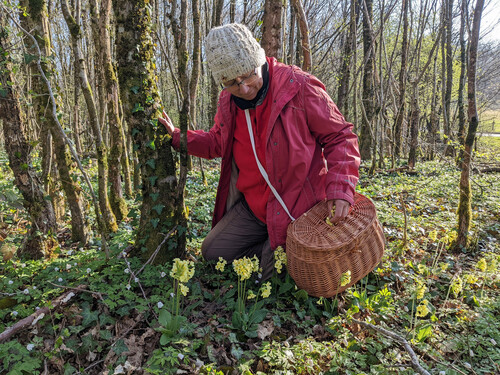
Other plants, like fragrant violets and cowslip, are less abundant around my house, whereas they were everywhere when I was a kid. I remember coming home from school with bunches of primroses, probably to make amends for something. Although, if you think about it carefully, I don’t see at all what stupid things I could have done as I was the model little girl! Huh, of what? Now, when I find cowslip during a nature walk, I pick them sparingly.
The idea of the autarkic garden brings together “local” plants. Of course, “local” has a different meaning depending on the habitat of each person. Being based in eastern France, I have some plants that have trouble surviving in my garden without my help, such as lemon verbena, especially because of the cold winter that can sometimes last a long time. When I think local, I think primarily of plants from France and northern Europe, they grow almost everywhere. The plants to be added to our database will first of all be plants that I find in my close neighborhood, wild and cultivated. I think I already have something to do. I will expand my field of action as I progress.
Of course, there are essential plants that grow in these faraway countries, like turmeric or devil’s claw. Even if they are not part of my close environment, they may have their small place in the database because they are so precious because of their virtues.
See you very soon for the next phyto-info newsletter!
sylvie